Introduction
Last modified:
Dintero Checkout for WooCommerce is a plugin that extends WooCommerce allowing you to accept payments via Dintero. It replaces the standard WooCommerce checkout page.
- Dintero Checkout for WooCommerce supports High-Performance Order Storage (HPOS).
Dintero Checkout does not support the Checkout block in WooCommerce.
You can read more about this here.
Sign up with Dintero
You need a business account with Dintero to be able to use this plugin.
Required WordPress/WooCommerce settings
- Make sure that you have enabled pretty permalinks in your WordPress installation. Otherwise callbacks from Dintero back to your store won’t work and orders will not be updated with the correct order status/information.
- To get the order total to match between WooCommerce and Dintero you need to configure WooCommerce to display prices with 2 decimals. More information about displaying of prices and how it can cause rounding issues can be found in this article.
- You need to have an active SSL Certificate and HTTPS activated.
- Your checkout page must use the Classic Shortcode block. Dintero Checkout does not support the Checkout block at this point. You can read more about this here.
- You can not alter, or add to, the
[woocommerce_checkout]shortcode when this is used.
Installation
- Download the plugin .zip file.
- Navigate to WordPress Admin → Plugins → Add New and Upload Plugin the file you have downloaded.
- Install Now and Activate.
Setup and Configuration
Before you get started you need to make sure you are using the checkout shortcode on your set Checkout Page.
The Checkout block is the default for new WooCommerce installations as of version 8.3. Dintero Checkout for WooCommerce does not yet support this.
Go to Pages → your set Checkout Page and transform the Checkout block to the Classic Shortcode block.

Once you have installed the plugin and set up your Checkout page, you need to configure the plugin in accordance to the steps below:
- Navigate to WooCommerce → Settings → Payments → Dintero Checkout
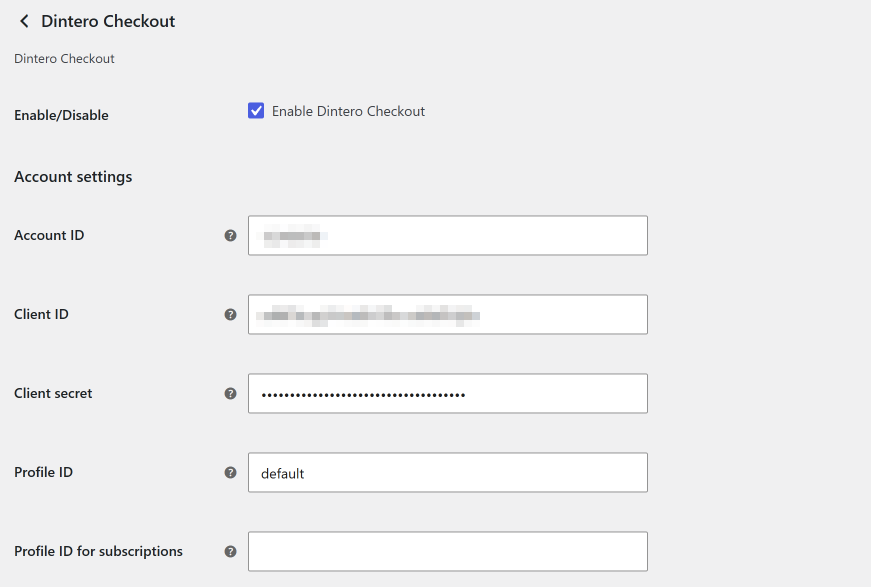
- Enable/Disable – Check the Enable Dintero box to activate.
Dintero configuration / Account settings
- Account ID – Enter your Dintero account ID. This can be found under Settings → Account info in the Dintero Backoffice.
- Client ID – Enter your Dintero client ID. This can be found under Settings → API Keys in the Dintero Backoffice.
- Client secret – Enter your Dintero client secret. This can be generated under Settings → API Keys in the Dintero Backoffice.
- Profile ID – Enter your test payment window profile ID. Found under Settings → Payment windows in the Dintero Backoffice.
- Profile ID for subscriptions – Enter the profile ID to apply if the cart or order contains subscriptions. You can find this under Settings → Payment windows in the Dintero Backoffice.
Checkout settings
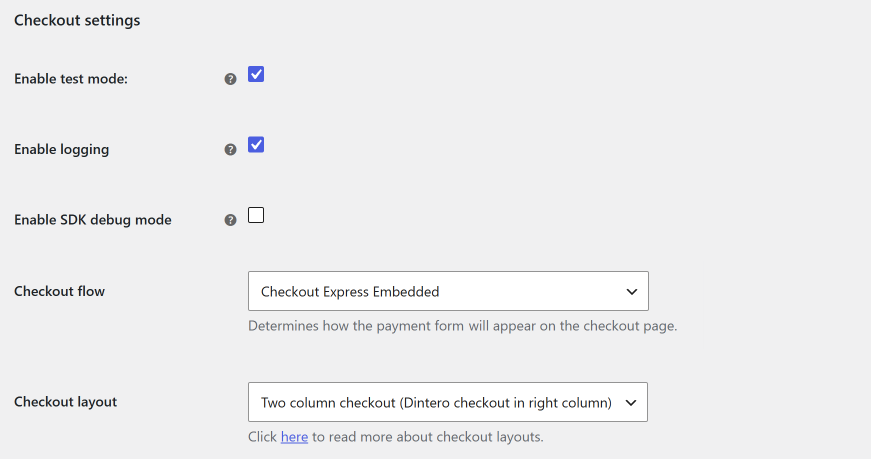
- Enable test mode – Check the box to place the payment gateway in test mode.
- Enable logging – Check the box to activate the feature save debug messages to the WooCommerce System Status log
- Enable SDK debug mode – Check the box to activate the feature. This logs the activity of the Dintero checkout SDK to the browser console.
Note: Only enabled while troubleshooting, since the output contains the full payment session. - Checkout flow – Choose the type of checkout you want to use on your site: Checkout Express Pop-out, Checkout Express Embedded, Checkout Redirect, Checkout Pop-out or Checkout Embedded.
- Checkout layout – Change the layout of the checkout. Choose between One column checkout, Two column checkout (Dintero checkout in right column) or Two column checkout (Dintero checkout in left column).
This only applies if you use either the Checkout Express Embedded or Checkout Express Pop-out flow.
Checkout Redirect settings
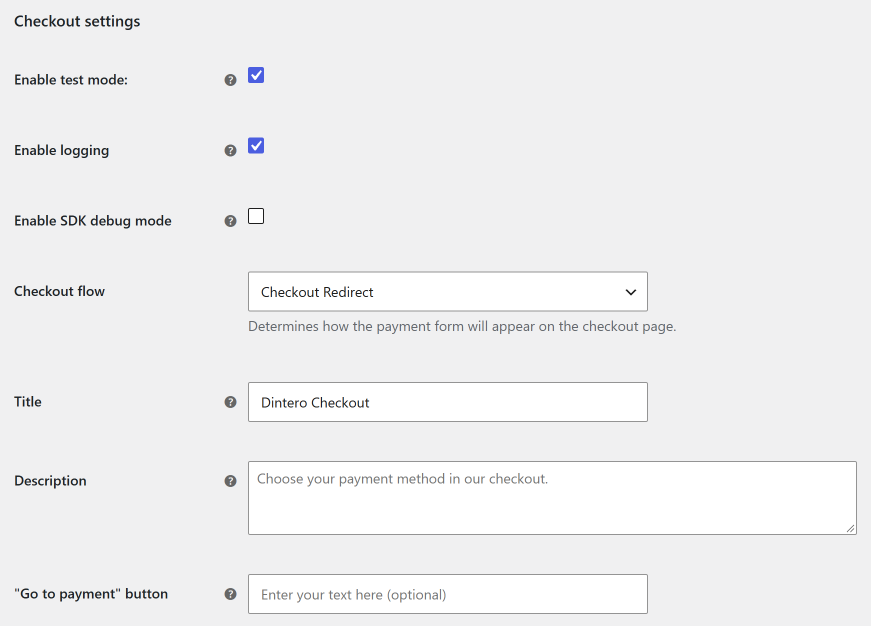
If you choose a Redirect checkout you will get some additional settings not necessary for the Embedded or Pop-out checkouts.
- Title – Enter the title for the payment method displayed in the checkout and order confirmation emails.
- Description – Enter the description of the payment method displayed in the checkout page.
- “Go to payment” button – Customize the “Go to payment” button text that is displayed in checkout if other payment methods than Dintero Checkout are available. Leave blank to use the default (and translatable) text.
Order statuses
- Default order status when authorized – Choose between Processing and On-hold as the default order status when authorized.
- Default order status when pending authorization – Choose between Manual review and On-hold as the default order status when pending authorization.

Order management settings
- Refund by changing order status – Check this box to trigger a refund in Dintero when WooCommerce order status is manually changed to Refunded.

Dintero Checkout Express Settings
- Allowed customer types – Set the type of customers allowed in your store. Choose between Consumers and businesses, Business only or Consumer only.
- Display Shipping Checkout Express – Check this box if you want the shipping selection to happen in the Dintero checkout iframe instead of the shipping section in WooCommerce.
- Allow separate shipping address – Check this box if you want to allow separate billing and shipping addresses. By default the billing address is used as the shipping address.

Please note that if you have Display Shipping in Checkout Express setting active, you need to have the correct shipping methods set up under WooCommerce → Settings → Shipping.
Read more about how to set up shipping in the iframe.
Branding
These settings control the Dintero Checkout Branding widget.
- Logo color – Choose if you want to use the Default color or Custom color.
- Logo variant – Switch between Logomark, Light mode or Dark mode. Only applicable when Default logo color is used.


Order Management
When an order is created in WooCommerce and a reservation number exists in Dintero’s system, you have the possibility to handle the order in Dintero directly from WooCommerce. This way you can save time and don’t have to work in both systems simultaneously.
Read more about order management in Dintero’s system directly from WooCommerce in the Dintero Checkout Order management documentation.
Currencies
The plugin itself has no limitations regarding currency.
However, please note that Dintero only works in the Nordic countries and there can be limitations in the agreement you have with Dintero.
When it comes to questions regarding supported currencies you should always talk to your payment provider. The exception is when the plugin in fact does have limitations.
Subscription support
Dintero Checkout is compatible with the WooCommerce Subscriptions extension for handling recurring payments.